Import: Database or Package
ℹ️ Info Applies to: OnPrem customers; primedocs desktop, primedocs web, OneOffixx
Concerns: Administrators
Instructions (short)
- Open the Dashboard (requires the corresponding permissions)
- Upload the ZIP file via the Smuggler (database/package)
- Select a database on the Dashboard start page.
- Select the desired import variant via the gear icon.
- Go to: Package Import
- Go to: Database Import
- Synchronise the client.
Instructions
Open the Dashboard in your browser: Open the Dashboard
Only users who have been authorised in the corresponding file located on the application server have access. If you do not have access but require it, contact your internal administrator.
Smuggler: Uploading files
Before you can import the package or the database into your database, the file must first be uploaded to the Dashboard:
- Click the user name at the top right and then on smuggler

- You can then upload the
zipfile (database) oroopxfile (package) by clicking on Select files or dragging the file into the field. The corresponding file is displayed below. - Then click on Upload All to upload the file(s)
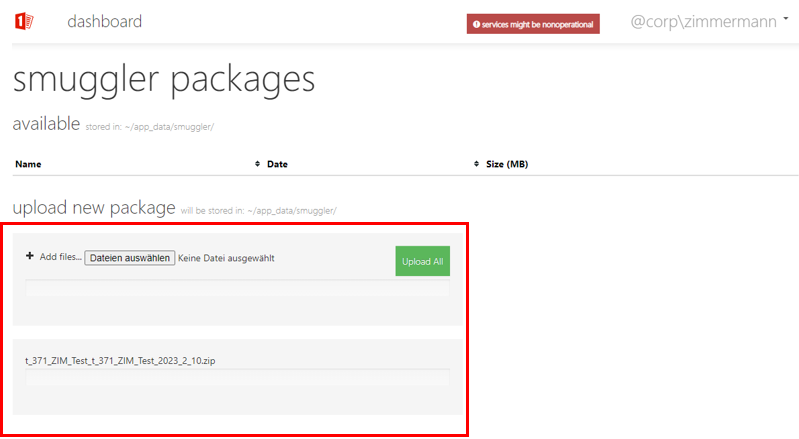
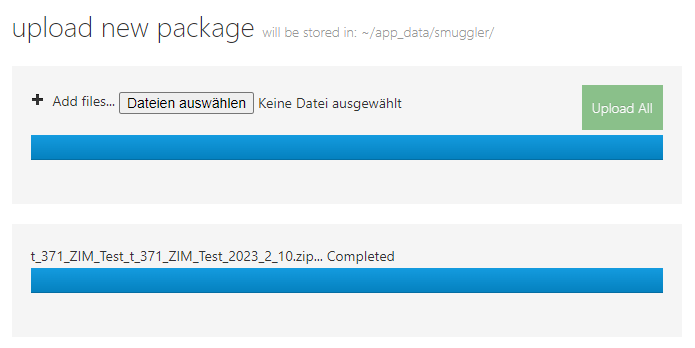
- The file is now uploaded and is now available for the next steps.
Selecting the export variant
- Go back to the start page of your Dashboard and select the database into which you want to import something.
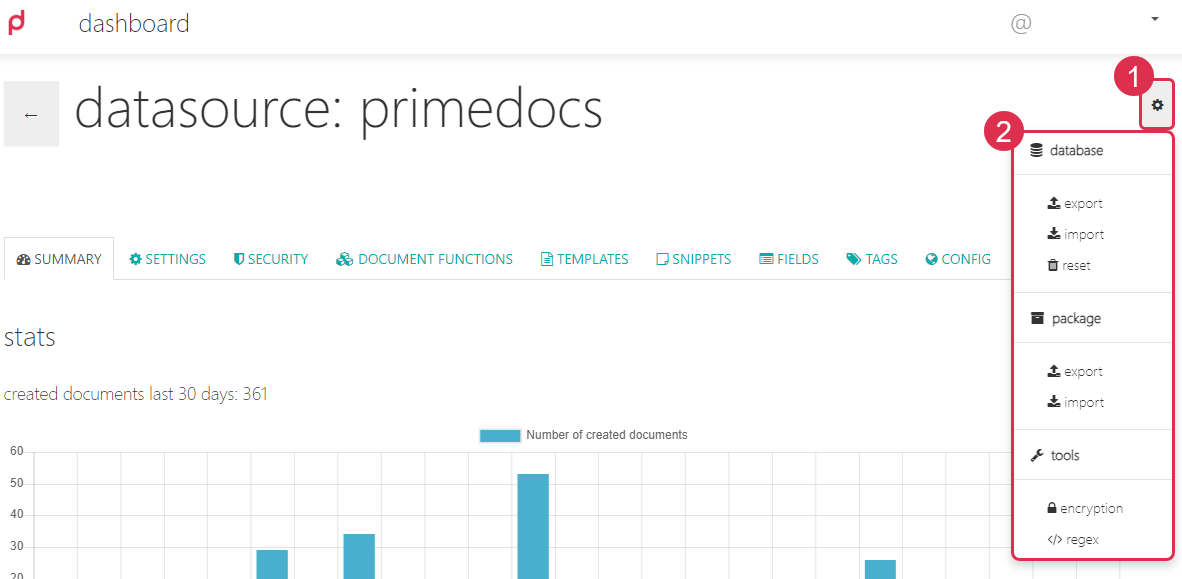
- Click on the gear icon and select the desired import:
- Package Import: Import individual templates, snippets etc.: an
oockfile is imported. - Database Import: Import an entire database: a
zipordacpacfile is imported.
- Package Import: Import individual templates, snippets etc.: an
Database Import: CAUTION, take care here! Only import databases when you are on a test database and NEVER into a productive database!
Package Import
- Click on the gear icon at the top right and select package → import.
- Select the desired package that you want to import.
NOTE
If the desired file cannot be selected here, it was either forgotten to upload it (see step Uploading files), or it is the wrong file format (the selected file must be an oopx file).
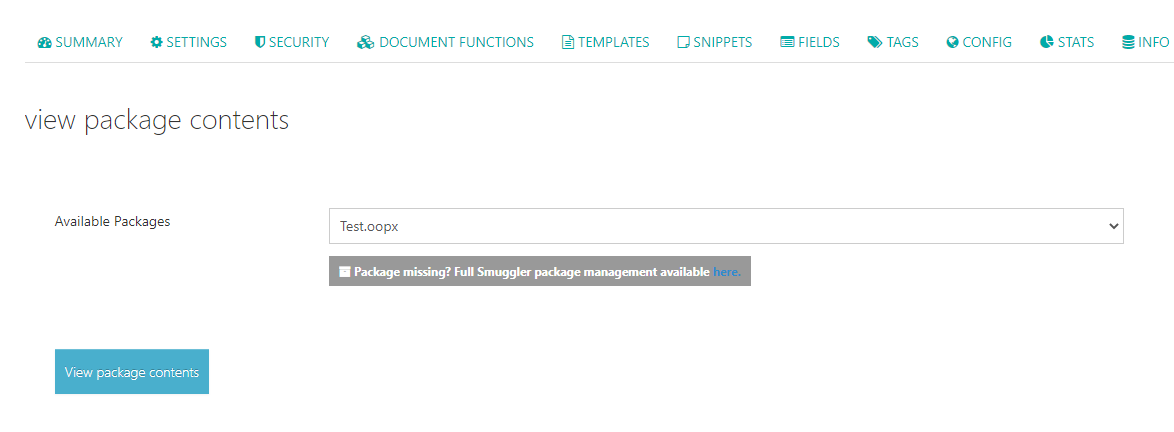
- Click on View package contents and look at the contents of the package.
Navigation
- To get to the next step, click on the Next button or alternatively directly on the desired packaging step at the top of the overview (Templates > Snippets > […] > Organization Unit).
- Note the button with the wrench ✅ below the export button. Here you find options for selecting and deselecting elements at the respective packaging step.
Checking the selected elements
- Go through each step and check the elements that were selected automatically:
- The import function recognises which data in the package differs compared to your selected database - and selects it automatically.
- Data that has changed is selected and marked.
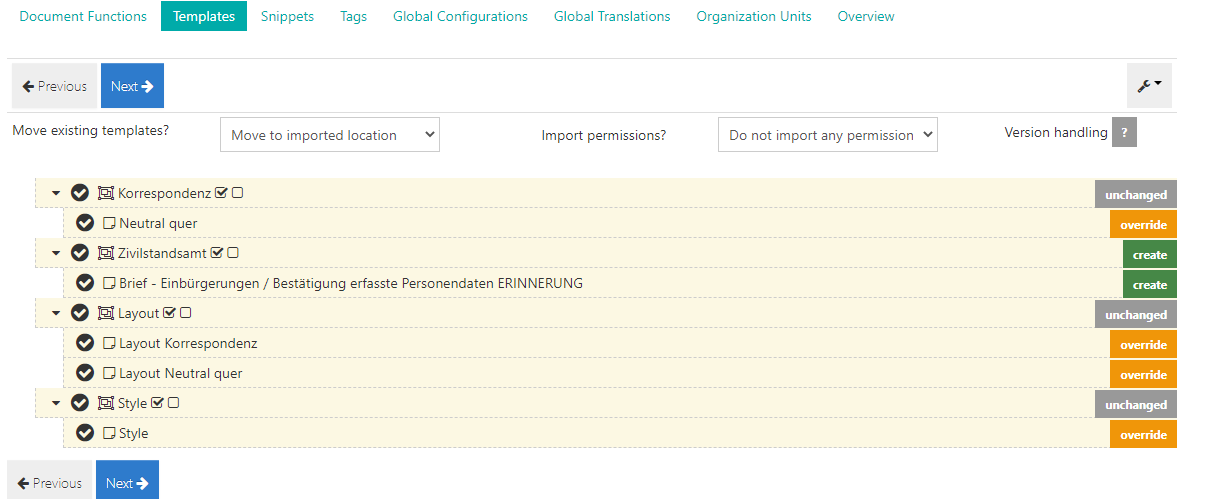
- unchanged = The element in the package is unchanged or identical → the import ignores it.
- override = The element in the package is different → the import overwrites the element.
- create = The element in the package does not yet exist → the import creates a new one.
- Deselect the elements if you do not want to import them.
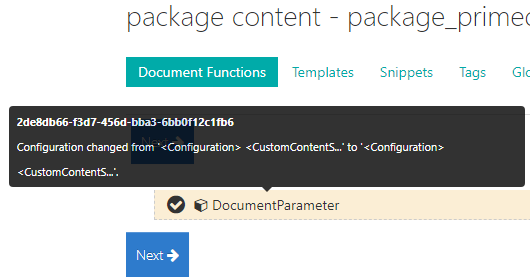
- You can read what has changed by hovering with the mouse over the label of an entry:
- Since the data marked with override or create is selected automatically, you only need to check whether you really want to import it.
Options when importing
- These options are displayed to you in the following steps: Templates, Snippets, Organization Units.
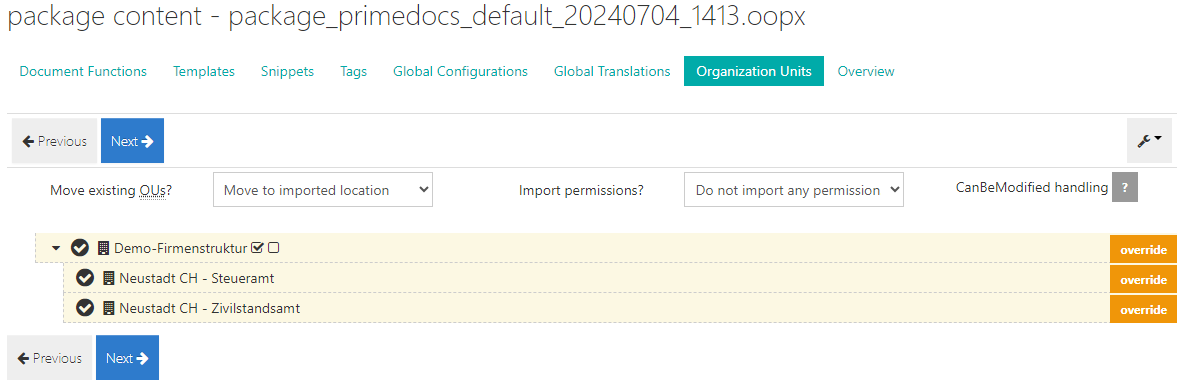
- Option: Move existing OUs? The element to be imported is moved to where…
- "Move to imported location": where it was in the source database.
- *"*Keep at existing location": where it already is in the target database.
- Option: Import permissions?
- "Do not import any permission": No permissions are imported. Select this option if you deploy different authorisation concepts for your databases or if the permissions in the target database may not be overwritten.
- "Import all permissions. Fails if any necessary security account is not present.":
- An attempt is made to import permissions.
- The import is aborted if there are users/user groups that are not found in the target database.
- "Import all permissions if possible. Permissions with missing security accounts are ignored.":
- An attempt is made to import the permissions.
- The import is carried out through to the end, even if there are users/user groups that are not found in the target database. That is, these users/user groups are simply ignored.
If you are unsure how to proceed with the Package Import, ask our support.
Document Functions step
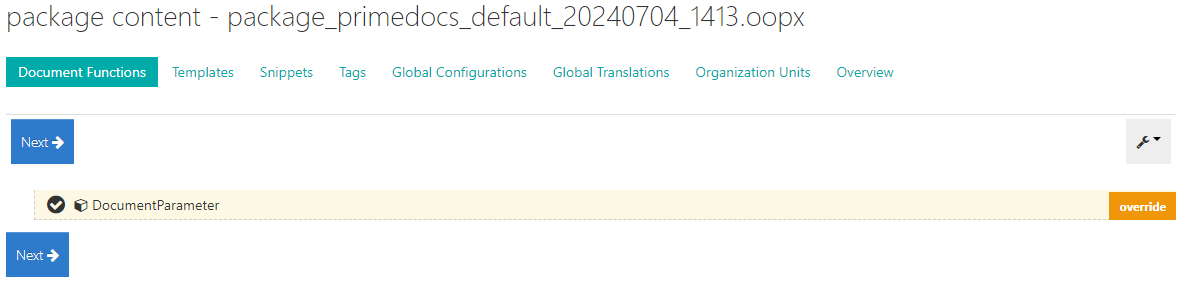
- Check whether you want to import the pre-selected global document functions.
Templates step
- Check whether you want to import the pre-selected templates.
- Deselect the templates if you do not want to import them.
- Note the options when importing.
Note that the template folder must always be selected if a template contained within it is to be imported.
Snippets step
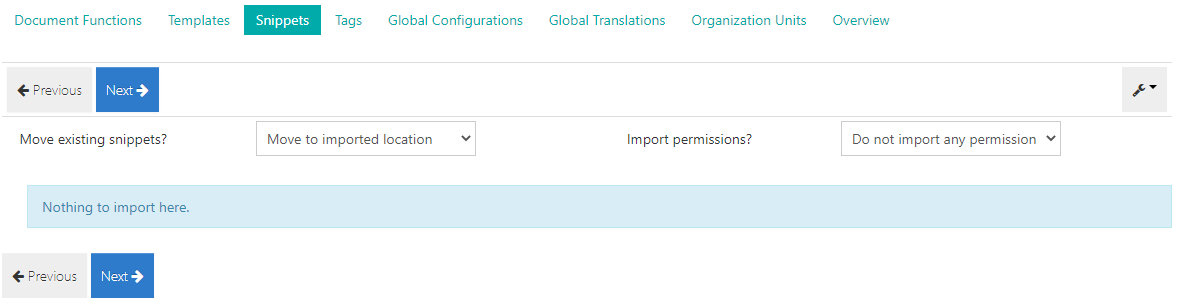
- Check whether you want to import the pre-selected snippets.
- Deselect the snippets if you do not want to import them.
- Note the options when importing.
Note that the snippet folder must always be selected if a snippet contained within it is to be imported.
Tags step
Check whether you want to import the pre-selected tags and deselect them if you do not want to import them.
Global Configurations step
Check whether you want to import the pre-selected global configurations and deselect them if you do not want to import them.
Only entire global entries can be imported.
Global Translation step
Check whether you want to import the pre-selected global translations and deselect them if you do not want to import them.
Organization Unit step
- Check whether you want to import the pre-selected organisational units and deselect them if you do not want to import them.
- Note the options when importing.
Note that the higher-level organisational units must always be selected as well if a sub-organisational unit is to be imported.
Overview step
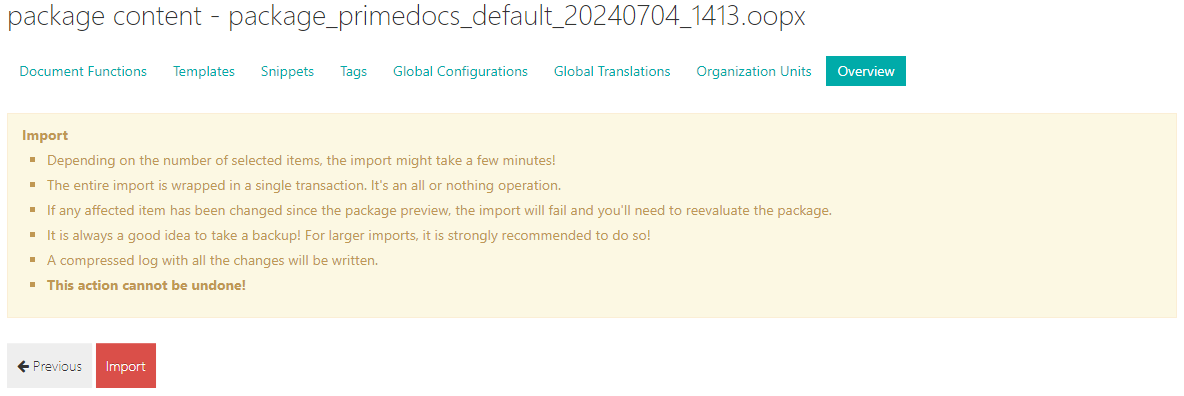
Here it is pointed out once again that during the import all data that you have selected will be overwritten and that this action can no longer be undone.
TIP
If you are unsure whether or not you want to import something, it is better to quickly do a Package Export of the corresponding elements as a backup before the import!
If you agree, click on Import.
After the import is complete, the following message appears:
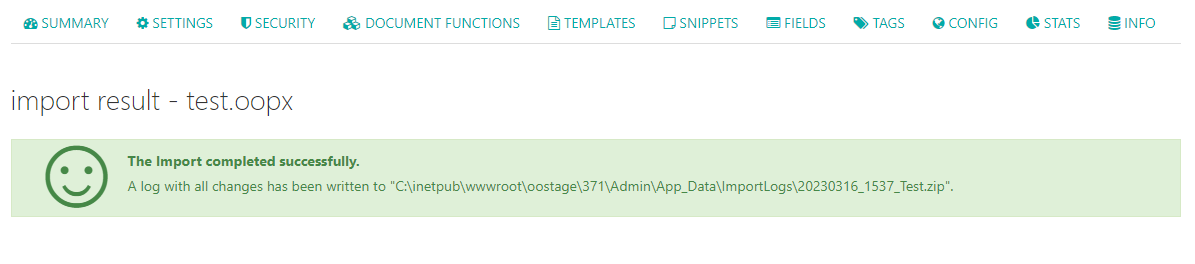
Now it makes sense to test the imported elements. To do this, primedocs desktop must first download the data from the database. To do so, synchronise the client: Desktop: Synchronise the client, so that you can see the new data in primedocs desktop.
Database Import
- Click on the gear icon at the top right and select database → import.
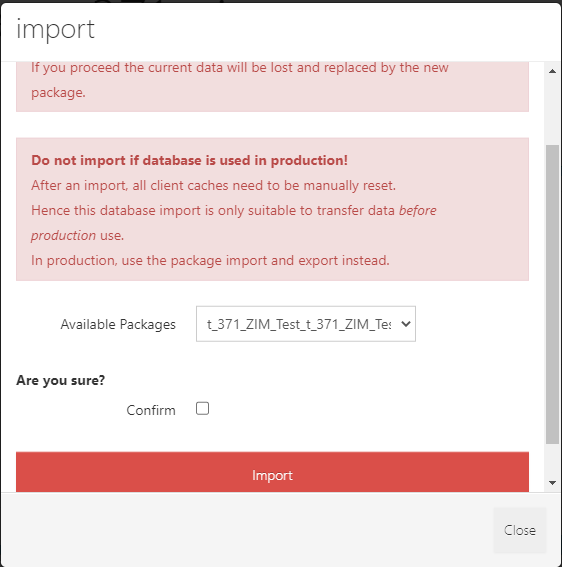
- Select the database that you want to import and confirm with Confirm.
- Clicking on Import imports the database.
CAUTION
READ the note in the pop-up window carefully:
Are you on the correct database? Do you really want to import this database here?
Only import database exports into test databases and NEVER into productive ones!
ℹ️ Info NOTE
If the desired file cannot be selected here, it was either forgotten to upload the file (see previous step), or it is the wrong file format (e.g. if you uploaded a package instead of the database).
You can find the instructions on how to export a database or carry out a package export here: Export: Database or Package